

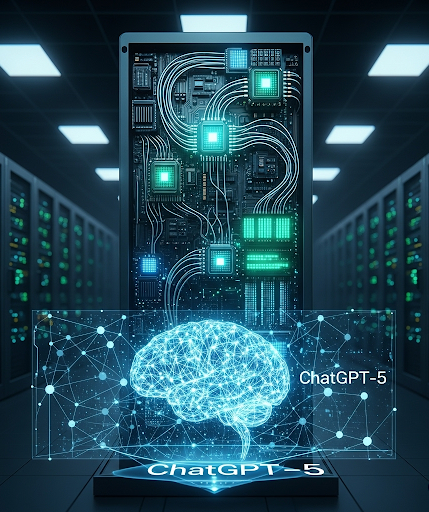
The tech world is buzzing with anticipation for OpenAI’s next flagship model, presumably named ChatGPT-5. The predictable speculation revolves around quantitative leaps: a context window in the millions, lightning-fast response times, and near-flawless accuracy. While these improvements are almost certain, to view them as the main event is to miss the forest for the trees. The true revolution of ChatGPT-5 won’t be that it’s a better tool; it will be that it ceases to be a tool at all, evolving into something more akin to a persistent, cognitive partner.
The paradigm of AI interaction is about to undergo its most significant shift since the dawn of the chatbot. We are on the cusp of moving from a reactive, command-based relationship to a proactive, ambient one. Here’s what makes this next leap qualitatively different from all that has come before.
Beyond Brute Force: The Efficiency Revolution
The current race in AI has largely been a contest of scale—more data, more parameters, more computational power. This approach, while effective, is hitting a wall of diminishing returns and unsustainable energy costs. The architecture of models like GPT-4, while powerful, can be likened to using a sledgehammer for every task, from cracking a nut to driving a nail.
ChatGPT-5 will likely represent a fundamental shift towards architectural efficiency. We can expect to see highly sophisticated Mixture-of-Experts (MoE) models, where instead of the entire neural network firing for every query, the system intelligently routes a prompt to specialized “expert” sub-networks. Think of it as evolving from a single, giant brain that knows everything to a council of dedicated specialists—a logician, a poet, a mathematician, a visual artist—who collaborate to generate a response.
This leap means that the model’s effective intelligence won’t just be a function of its size, N, but of its ability to combine specialized components in complex ways, potentially solving problems with a computational complexity far lower than its predecessors. The result isn’t just speed; it’s a more nuanced and contextually appropriate form of reasoning.
The Emergence of the Proactive Agent
Our current interactions with AI are transactional. We prompt, it responds. It waits for our command. This is the core limitation that ChatGPT-5 is poised to shatter. The next iteration will likely feature persistent memory and the capacity for autonomous, long-term goal-seeking.
Imagine an AI that is not confined to a chat window but exists as a persistent layer across your digital life.
- Instead of asking it to summarize your morning emails, it will have already done so, flagging the two that align with the “Project Alpha” deadline it knows you’re worried about and pre-drafting a reply to a third.
- Instead of you asking it to plan a vacation, it might proactively notify you: “Based on your calendar availability in October, your stated interest in ancient history, and a 30% drop in airfare, I’ve outlined a potential 7-day itinerary for Rome. Would you like me to explore accommodation options?”
This isn’t just an assistant; it’s a cognitive co-processor. It anticipates needs, manages complex workflows in the background, and executes multi-step tasks without continuous human intervention. This leap from reactive tool to proactive partner is the single most significant evolution we will witness.
Multimodality as a Native Language
While GPT-4V introduced impressive multimodal capabilities, it still largely “translates” between modalities. It sees an image and describes it with text. ChatGPT-5 promises true, native multimodality, where data from different streams—vision, audio, data tables, and text—are not translated but fused into a single, unified conceptual understanding.
Consider the practical implications:
- A doctor could show the AI a patient’s EKG readout (data), their medical history (text), and a video of their physical state (vision) for a holistic diagnostic suggestion that considers all inputs simultaneously.
- An engineer could have a live video call to troubleshoot a piece of machinery. The AI would listen to the engine’s sound (audio), watch the engineer’s hands (vision), and pull up the relevant schematic (data) in real-time, guiding the repair with a true understanding of the multi-faceted problem.
In this new paradigm, the AI doesn’t just process inputs; it perceives a rich, layered reality much like a human does, only with an infinitely larger knowledge base.
The New Frontier: Trust and Governance
This evolution from a tool to a partner forces us to confront profound questions of trust, autonomy, and ethics. When an AI can act on our behalf proactively, the stakes are exponentially higher. The black box problem—not fully understanding how an AI arrives at a decision—becomes a critical liability.
The development of ChatGPT-5 must, therefore, be as much about philosophy and governance as it is about computer science. We will need new frameworks for “explainable AI” (XAI) and digital constitutionalism that can audit and constrain these powerful agents. How do we ensure a proactive AI is truly aligned with our best interests? Who is liable when an autonomous agent makes a catastrophic financial or personal decision on a user’s behalf?
The arrival of ChatGPT-5 will mark the end of one era and the beginning of another. The conversation will shift from “What can I ask the AI?” to “What is my AI working on for me right now?” We are not just building a more knowledgeable chatbot. We are architecting a new kind of relationship with a new digital intelligence. The real test will not be in the lines of code, but in our wisdom to manage a partner that may soon understand our world better than we do. You can visit the given url https://openai.com/gpt-5/